
Custom Jewelry Orders
How to protect your interests
and make custom orders profitable
by Rena Klingenberg. © 2003-Present Rena Klingenberg. All Rights Reserved

Making custom jewelry can be a nicely profitable part of your business, if you follow a few simple procedures to protect yourself and prevent misunderstandings with the customer who ordered it.
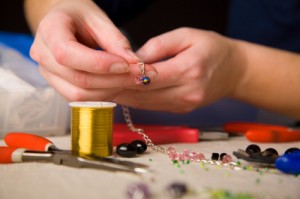 When someone requests custom jewelry, discuss their idea of the finished piece so that you have a clear understanding of what they expect.
Often customers are very receptive to your suggestions to improve on their ideas, so don’t hesitate to tactfully brainstorm the design with them, or suggest materials or design ideas they may not have considered.
Work Up a Price Quote
for Custom Jewelry Orders
Once you’ve settled on the custom jewelry design, don’t let your customer pressure you into giving them a price quote immediately, before you’ve had time to research your materials cost and availability, and figure approximately how much time you’ll spend making the piece.
Even if your customer says, “Oh, just give me a rough estimate,” you’re better off waiting till you’ve had the opportunity to figure an accurate quote.
The customer won’t be happy if your final price comes in higher than your off-the-cuff verbal quote, and you want to be sure you’re adequately compensated.
So it’s best to simply and politely say that you have to do a bit of research before you know how much it will cost, and that you’ll get back to them immediately.
Then go off and work up a price quote for the item.
Charging for Extras
If a custom piece involves extra effort or time on your part, don’t be shy to charge for it.
People understand that custom work in any industry usually costs more.
And be sure to include any cost of having the supplies for the custom jewelry order shipped to you, if you have to order components individually from your suppliers instead of bulking them into one of your standard supply orders.
If the custom jewelry is to be a rush job, remember to charge an adequate but fair amount to cover that aspect of the project, especially if you’ll incur extra expenses to meet their tight deadline.
Most businesses charge additional fees for “hurry up” jobs, because rushing is usually not the most economical way of getting supplies and doing the work.
Your customer should understand that rush charges may be included in the final cost.
Giving the Customer
Your Price Quote
Once you’ve worked up a realistic price that is profitable for you and fair to your customer, get back to your customer the very same day (or as soon as possible) with your researched quote.
Write Up a
Custom Jewelry Work Agreement
Once your customer has agreed to your price quote, it’s time to write up a brief custom work agreement.
This easy step can save you time and money, and will prevent problems and headaches later!
This simple contract can be an email or a single written page.
It ensures that both you and your customer have the same expectations – and that neither of you will be unpleasantly suprised by misunderstandings.
Elements to Consider Including
in Your Custom Work Agreement:
- The date.
- Your name and contact info.
- The customer’s name and contact info.
- A simple written statement describing the work the customer expects:In addition to words, you may want to include sketches of your idea of the finished piece, from a couple of different angles.
- Your price quote.
- The date you expect to deliver the finished jewelry to the customer:Be sure your estimated date for finishing the custom jewelry is realistic.
It’s a good idea to calculate how long it will take your supplies to arrive, how long to make the jewelry, and then add in a few extra days in case of unforeseeable delays.
It’s better to tell your customer the jewelry will take 10 days and then pleasantly surprise them by having it ready in 7 days, than the other way around.
If there is some unforeseeable delay after you sign the custom work agreement, contact the customer immediately and explain what’s going on and when you expect to have the project finished.
Keeping them up to date on the situation if there’s a delay enhances your professional reputation, and can keep a customer from being upset!
- Your terms:To protect yourself, your terms should state that payment in full (or at least a non-refundable 50% of the total payment) must be received by you BEFORE any supplies are ordered and any work begins.
And if you require only 50% as a down payment, state that the remaining 50% is due when the piece is finished – at the time you deliver the jewelry to them.
Why get at least half of the money up front?
Nearly every jewelry artist who has done custom work has experienced customers who either “changed their minds” and decided not to buy a custom piece after it was finished, or never responded to phone messages and emails telling them their order was ready.
You never know why someone might change their mind between ordering custom jewelry and seeing the finished piece.
Perhaps they couldn’t afford it to begin with, and are embarrassed to tell you so.
Or maybe their spouse was upset about their spending, or they just went home and had buyer’s remorse.
Whatever the reasons, it’s not unusual for customers to change their minds about custom orders, so you need to protect yourself.
Sometimes a custom piece is so specialized or unusual that no one else would ever want to buy it, which can be a costly waste of your time and supplies if you didn’t get a down payment for your work.
So wait to order any supplies until you actually receive your customer’s full payment (or 50% deposit, whichever you agreed on).
Most businesses that accept custom orders require full payment in advance.
- How alterations to the finished piece will be handled and charged:For example, custom resizing of jewelry that winds up not fitting the intended wearer should be covered under your original price quote.
However, redesigning the finished piece should incur additional charges.
Unfortunately there are some customers who want you to redesign the piece after it’s finished (“Oh, let’s put some pearls there, and change out the amethysts for garnets”).
Customers like this expect you to keep remaking the piece at no additional expense to them, without considering the cost of your materials and time.
So it’s a good idea to protect yourself with a statement in your terms that while custom sizing for fit is covered by your quoted price, reworking the design will incur additional charges for materials and your time.
- Your guarantee policy.
Signing the Work Agreement
When this custom jewelry work agreement is ready, present it to your customer.
Once you both agree to it, both of you should sign it.
This shows that both parties agree to the project, the quote, and the terms.
Let your customers know that this agreement protects them as well as you, especially since they will paying you for at least part of the job up front.
Give your customer a copy of the agreement, and keep one for yourself.
Deliver the Custom Jewelry
When the custom project is finished, call your customer and arrange to bring it to them.
Also, if you required only half of the payment up front, remind them that the final payment is due on delivery.
Package the piece nicely in a pretty gift box, pouch, or other decorative container.
For out-of-town customers, you can email them when the project is finished, including a photo of the finished piece, to get their approval on how it turned out.
Customers get very excited when they receive the photo!
In the email you can re-state the balance due and payment methods you accept, and let them know you’ll ship the piece as soon as their payment is received.
When you receive the final payment and ship the item, email them again to let them know you shipped it – including the shipping method and date.
If the custom jewelry you’ve just sold was a high-priced piece, you may want to send a handwritten thank-you note or email a few days later, to let your customer know how much you appreciate their business.

